Simplifying parking by reducing uncertainty and improving access to available spaces.
Project Overview
Transforming the chaos of city parking into a faster, more predictable experience
Parking in busy urban areas is an experience that often results in drivers frequently circling blocks in hopes to snag an available spot, contributing to congestion, wasted fuel and time, and heightened frustration.
This challenge reflects a broader issue in urban mobility - a lack of visibility into parking availability and poor integration of parking information into trip planning. How might we assist drivers in reducing congestion, travel time, and parking costs by monitoring real-time parking availability and traffic flow to provide route and directional updates towards convenient parking spots?
By providing pre-trip planning opportunities and concurrent updates, Find My Spot aims to enhance parking efficiency and minimize wasted time searching for spots.
Duration
3 Months (Oct– Dec 2024)
Responsibilities
UX research, sketching, wireframing, hi-fi prototyping, interaction design, iterative design.
Tools
Figma, Procreate, Adobe Photoshop
The problem
Parking exists, yet uncertainty dominates
Parking in busy urban areas should be predictable, especially for drivers trying to get where they need to go without added stress.
Instead, a lack of visibility into parking availability leaves drivers uncertain and frustrated, turning simple trips into time-consuming searches and often discouraging them from going out altogether.
a deep dive: user research insights
When parking feels uncertain, people end up avoiding experiences altogether.
To uncover this behavior, I focused my research on three key questions:
1) What are the biggest frustrations faced when looking for parking in urban areas?
2) How do drivers currently plan for parking, and what tools or strategies do they use?3) What factors influence a driver’s choice between one parking spot and another
These questions revealed that uncertainty around availability, pricing, and proximity, often deters people from going out entirely.
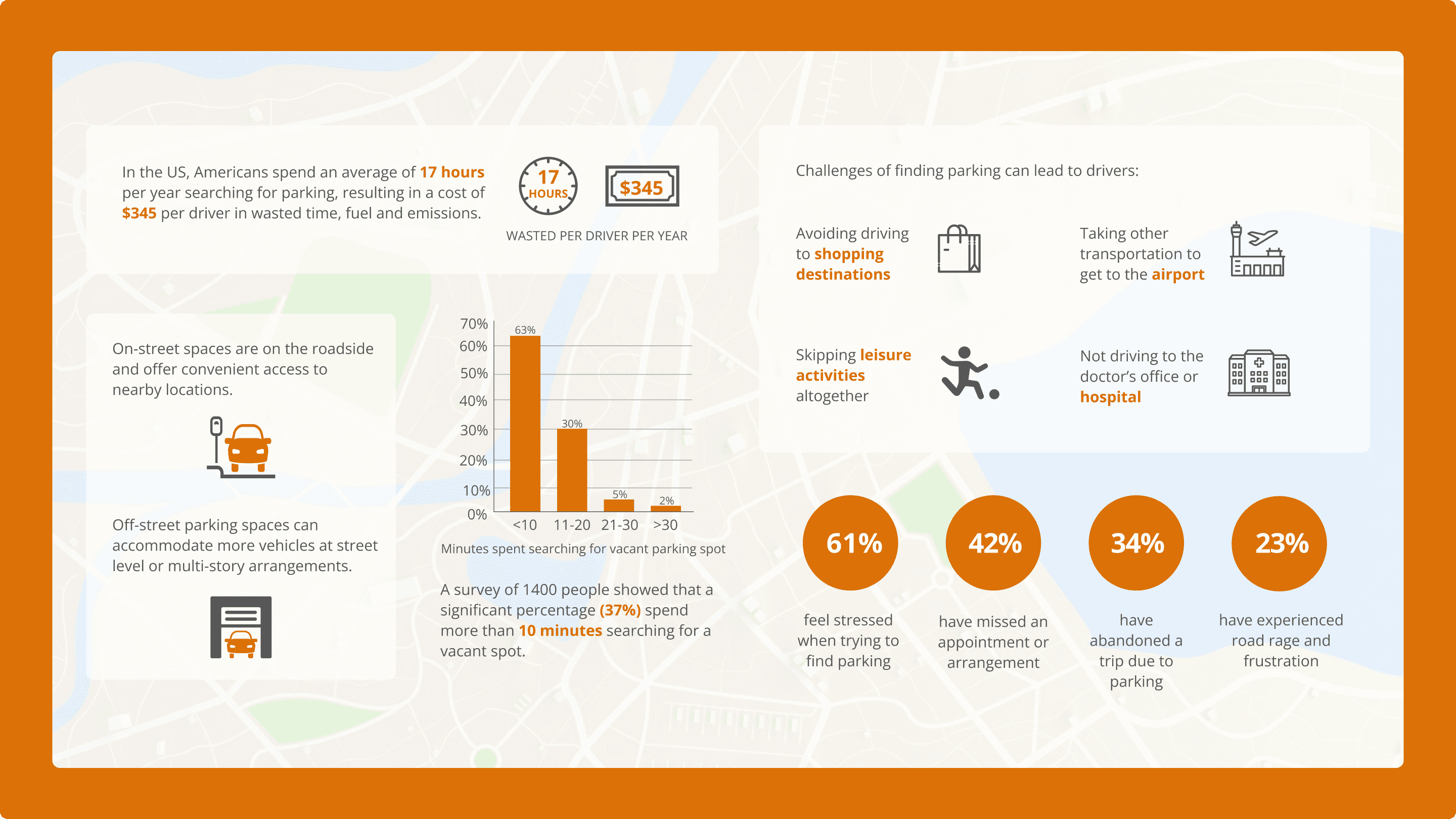
The primary source of stress is uncertainty
Drivers feel frustrated by not knowing what to expect, making visibility and predictability essential.
parking friction impacts daily behavior
Difficulty finding parking leads users to avoid trips, cancel plans, or pay more to reduce their stress.
it adds up - emotionally and financially
Time spent looking for parking adds up, reinforcing the need to minimize search time through better planning.
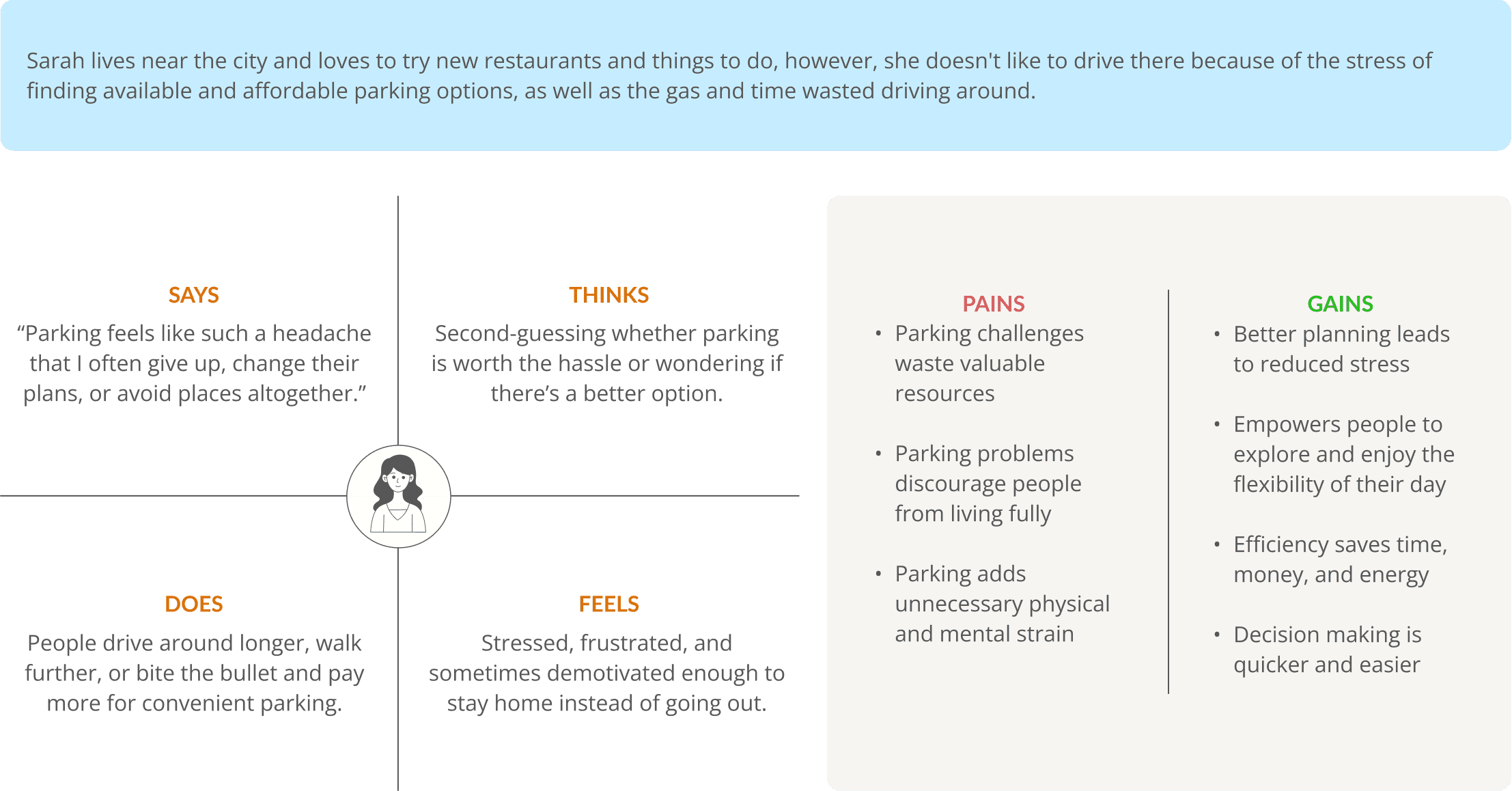
EMPATHY MAPPING
It’s not just the lack of parking options - it’s the lack of control.
Through user interviews and empathy mapping, I found that the core frustration isn’t just about availability, it’s the unpredictability. People like Sarah don’t just feel inconvenienced; they feel disempowered.
She often second-guesses whether going out is worth the stress of circling blocks, overpaying, or walking long distances. This uncertainty doesn’t just waste time and gas - it adds emotional strain.
The result? Avoidance behavior - canceling plans, staying home, or paying extra for peace of mind.
What users truly want is the ability to plan ahead, reduce friction, and feel confident that parking won’t derail their day's activities.
SMART ENVIRONMENT MAPPING
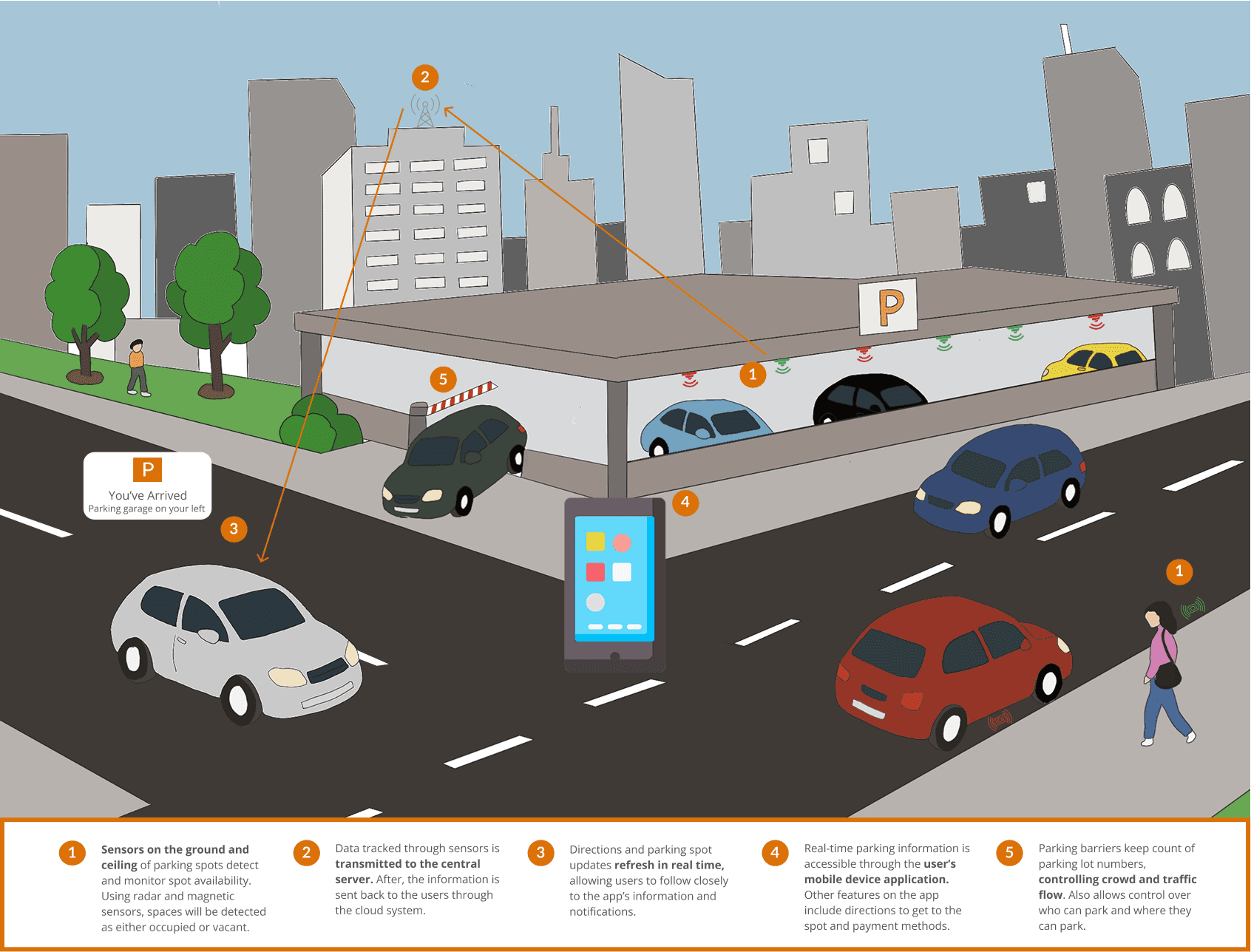
Mapping the system that supports drivers ahead of time
As I mapped out the system, I started thinking beyond just helping drivers find spots in the moment. The empathy map showed that stress often starts before the trip begins. That shifted how I visualized the solution: creating an environment that works before the driver even arrives.
It led to the concept of a connected system where sensors, real-time data, and proactive guidance work together to empower drivers before they even get behind the wheel.
WIREFRAME SKETCHING
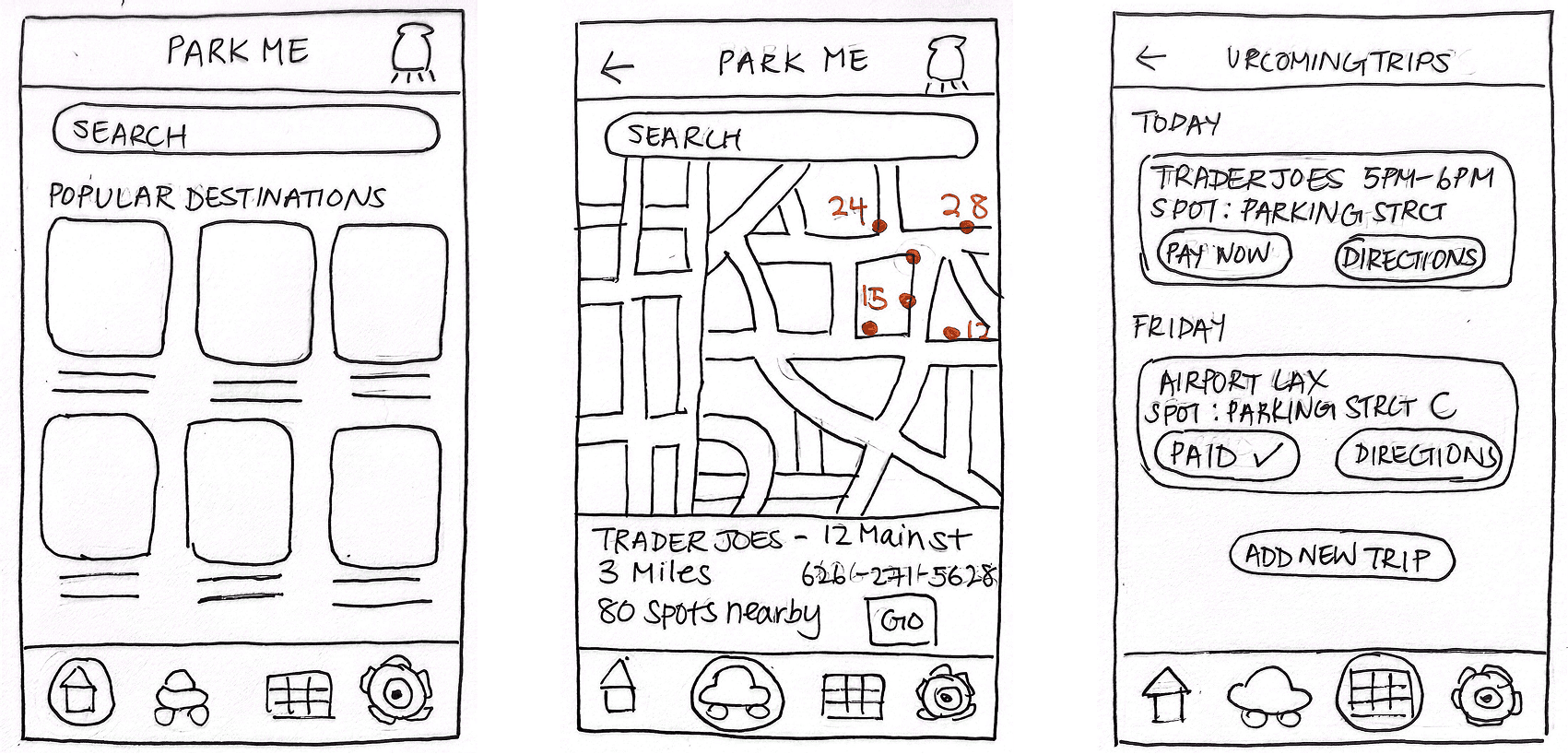
Parking should be effortless, so I wireframed to mirror ways they already explore
When I began wireframing, I aimed to create an experience that felt familiar and intuitive. Drawing inspiration from tools users already trust, like Google Maps, Apple Maps, and SpotHero, I focused on clarity, simplicity, and smart defaults.
Sketching helped align key features with how users naturally approach parking: through convenience, comparison, and planning. My goal was to reduce friction by mirroring existing behaviors.
THE FINAL PROTOTYPED DESIGN
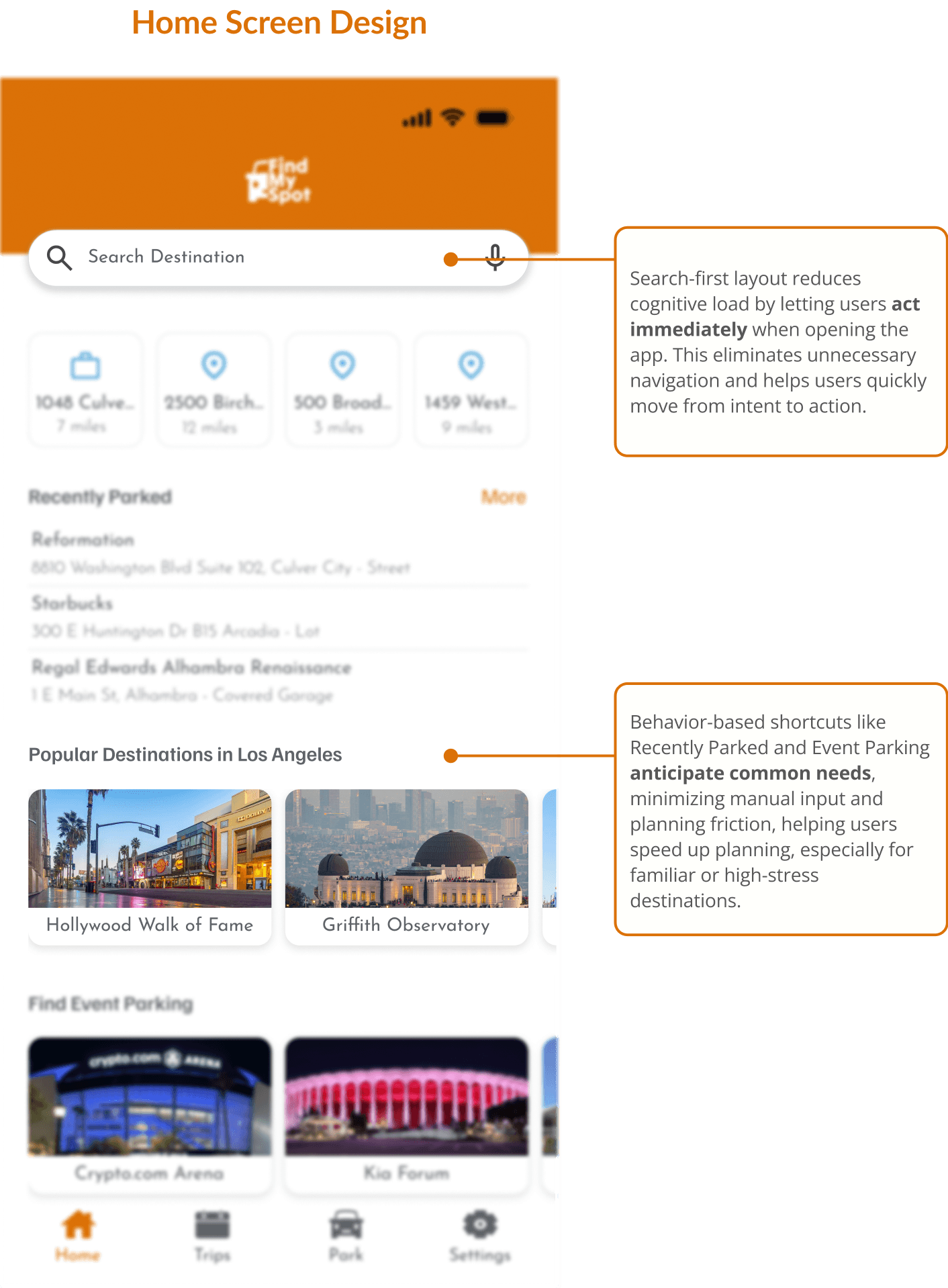
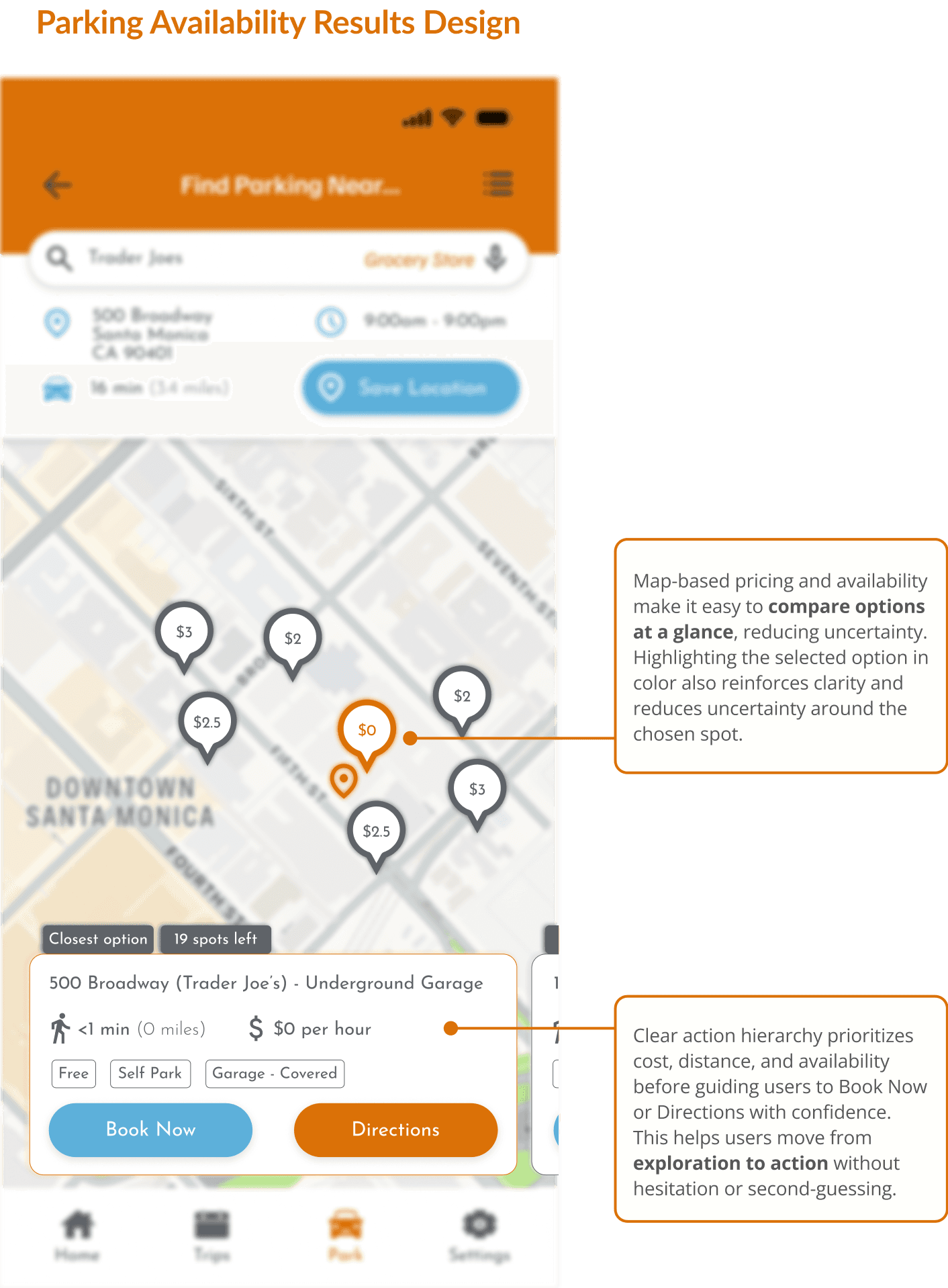
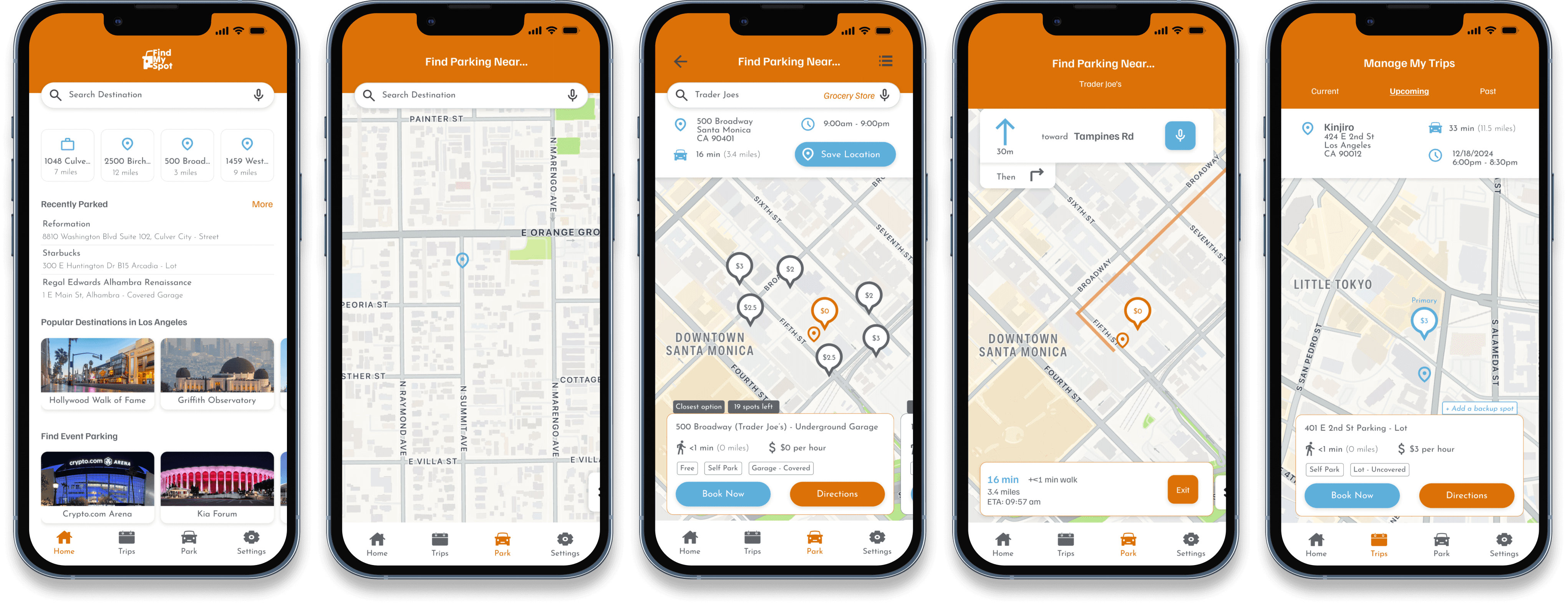
Designing for a consistent routine: helping users return to reliable parking builds trust
In my high-fidelity designs, I focused on supporting users’ habitual parking routines. By emphasizing consistency, predictability, and clear feedback, I aimed to build long-term trust. The goal wasn’t just to solve parking once, but to create a reliable experience users could return to again and again.